Weekly · from scratch · rotating partners
Tango Dance Classes in Sheffield
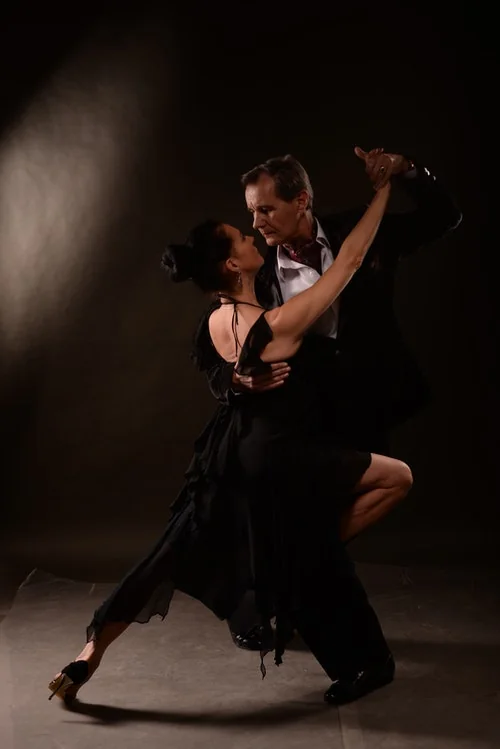
Our tango dance classes in Sheffield begin with something almost embarrassingly plain: walking. Everything after that — the embrace, the pauses, the ochos people film in Buenos Aires — is stacked on top of a walk that takes a few weeks to make honest. One hour, weekly, in a city-centre studio, with the room rotating so nobody has to arrive with somebody. Ten pounds a class; thirty-two for four weeks.
Your first tango
Ask about tango and we'll do the rest.
Tango runs weekly in Sheffield city centre. Mention whether you've partner-danced before — ballroom, Latin, anything at all — and we'll tell you which evening to walk into, what the class is working through and whether it matters that you're coming by yourself.
- £10 each time, or £32 paid once for four
- No partner required; the class rotates all evening
- Evening and address emailed back, usually same day
The essentials
- Where Sheffield city centre studio
- When Weekly, evening — sent by reply
- Length One hour
- Level Beginners upward
- Ages 17 – 75
- Partner Rotates through the class
The dance
Tango is a conversation, not a routine.
What tango in Sheffield feels like
Tango has no set sequence. Two people stand close, agree on a shared axis, and one of them proposes where the next step might go while the other decides how to answer it. That is why no two dances look alike, and why the learning curve behaves unlike anything else on our weekly timetable. Beginners spend those first weeks on posture and the walk, in the embrace and out of it, learning to travel with somebody else's weight rather than against it. Nobody counts out loud for long. It is slower than it looks from a distance and considerably harder than it looks on film.
The music does a lot of the work. Golden-age orchestras hand you a beat with room to breathe in it, so a pause counts as a move — a genuine relief for anyone who has felt hurried by faster Latin styles. Partners change every few tracks, which is not politeness but the quickest route to competence: leading somebody taller, following somebody lighter, adjusting each time, is what builds a dancer who can hold their own anywhere. The room tends to be a mix of people who found tango through a film, ex-ballroom dancers with tidy footwork and a steady handful of students who wanted something older than a club night.
How the hour is built
Posture and solo walking first, then technique inside the embrace, then a short sequence to finish — usually something you could dance socially rather than perform. Nothing is assessed, nothing needs a fixed partner, and there is no exam at the end of a block. Newcomers are looked after at the start of the hour rather than left to work it out from the back row. Dancers who want a brighter, faster cousin of the same partner logic often add ballroom, and a tango-flavoured first dance turns up in more Sheffield weddings than you would guess.
Four weeks in the embrace
From standing awkwardly to walking together.
The usual arc of a block, though the teacher follows the room rather than a plan on paper.
The walk
Posture, weight over one foot, and walking forwards and backwards in time. Unglamorous, and the most useful hour of the whole month.
The embrace
Making contact without gripping, finding a shared axis, and discovering that a lead comes from the chest rather than the arms.
Ochos
The figure-eight pivots that make tango look like tango, taken at half speed until the ankles stop objecting to them.
Dancing it
Walk, pause, ocho and a simple turn, put together to a real orchestra and danced socially with everyone in the room.
What else you get
What tango does while you're not looking.
People come for the dance and leave with the balance.
- Balance you notice on an icy pavement in January
- Posture that survives a full day at a desk
- Reading another person without either of you speaking
- Calm, from an hour of slow deliberate movement
- Ankles and feet that finally get used properly
- A social dance that works in any city in the world
- Patience, because tango punishes rushing
- Somewhere to be on the same night every week
Tango questions
What people want to know before they start.
Ten plain answers on tango in Sheffield, for anyone still deciding.
1Do I need a partner to learn tango?
No. Rotation is part of how the class is taught, which makes a solo dancer ordinary rather than awkward. If you would rather stay with the person you arrived with, say so at the start and nobody will move you on.
2Is this Argentine tango or the ballroom version?
Argentine in spirit: improvised, danced in a close embrace, made for a social floor rather than a competition one. Ballroom tango is a different animal with a fixed frame and that sharp head snap, and if that is what you are after, the ballroom class is the better door.
3I have no rhythm at all. Can I still do tango?
Tango is kinder about that than most styles, because the music leaves gaps and you are allowed to use them. Steps are placed rather than counted, and the teacher will spend as long as it takes putting a pulse under your feet. Plenty of people who say this end up leading.
4What shoes work for a tango class?
Something smooth-soled that stays on your foot: leather soles, a plain court shoe, or trainers that are not too grippy. Sticky rubber makes pivots hard on the knees, and tall heels can wait until much later. We neither sell nor lend dance shoes, so bring whatever you already have.
5Do I have to dance close to strangers?
Not until you choose to. Beginners work in an open embrace with a comfortable gap and only close it if and when that feels right. Nobody is asked to shorten the distance, and the teacher checks rather than assumes.
6Can my partner and I come to tango together?
Of course, and plenty do. You will be encouraged to swap now and again because it makes you both better dancers, but staying together for the whole hour is a request nobody is going to argue with.
7What does a tango class cost?
Pay £10 as you go, or £32 up front for four weeks, which saves you £8 across the month and works out at £8 a class. We do not run contracts, standing orders or joining fees of any description.
8Where is the tango class held in Sheffield?
Somewhere central: the studio sits inside the ring road, within walking distance of the tram stops and the main evening car parks. We send the door number and the floor along with your timetable rather than printing it here, because the room can change.
9When could I manage a milonga — a social tango night?
A four-week block usually gets people as far as dancing a whole track without stopping to think, which is the real milestone. Feeling relaxed at a milonga takes longer, and most dancers decide that part is the fun rather than the frustration.
10Can I come to tango once and decide afterwards?
Yes. A single class is £10 and commits you to nothing further. Come, dance, and make your mind up on the way home; if it turns out not to be for you, we will not ask twice.