Weekly · adults · absolute beginners welcome
Ballet Dance Classes in Sheffield
Most people who walk into an adult ballet room last did this aged seven, or never. Our ballet dance classes in Sheffield are built for exactly that: barre work at a pace you can follow, French words explained the first time they appear, and an hour that leaves your legs shaking and your posture two inches taller. £10 a class, or £32 for a block of four.
Book a first ballet class
Tell us where you're starting from.
Ballet meets every week at our city-centre studio. Say whether you danced as a child, gave up years ago or have never tried, and we will point you at the right hour and send the address with it.
- £10 on the night, £32 for four weeks together
- No previous training and no leotard required
- An email back with times, level and the way in
The essentials
- Where Sheffield city centre studio
- When Weekly, evening — sent by reply
- Length One hour
- Level Beginners upward
- Ages 17 – 75
- Partner Not needed
The technique
Ballet without the mirror-shaped fear.
What adult ballet actually involves
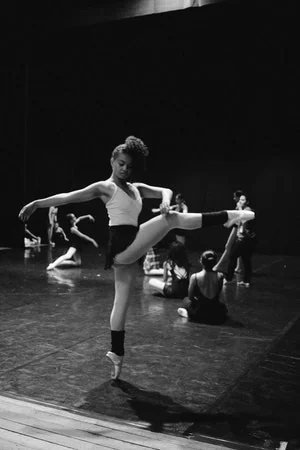
Ballet is the only style on our Sheffield class list that people apologise for wanting to do. The apology usually contains the words "at my age" or "in this body", and it is always unnecessary. Adult ballet is a technique class: you hold a barre, you work through the same sequence of exercises dancers have used for two centuries, and you get stronger. Nothing in it demands a particular shape, a particular past or a particular level of flexibility. It demands turning up and being willing to look faintly ridiculous for about three weeks. Most of our beginners have spent years being told, usually by themselves, that ballet is something you either started at four or missed for good. That is nonsense. Adults often pick up technique faster than children, because they can hear an instruction and apply it on purpose.
The hour splits neatly in two. At the barre you build vocabulary — pliés, tendus, rises, the small precise things that teach ankles and hips how to carry weight. In the centre you take a fragment of that away from the support and discover what your balance is really like. Progress here is quiet and then sudden: nothing appears to change for a month, and then one evening you notice you can stand on one leg while pulling a sock on. Nobody is timed, nobody is ranked and nobody is told anything about their weight; the only measure that counts is whether this week's plié is better than last week's.
Barre, centre and the bit in between
Expect roughly thirty minutes at the barre, twenty in the centre and a short travelling sequence to finish. Dancers who want the same discipline with more freedom often add contemporary once the basics are in, and couples preparing a first dance find that a term of ballet quietly fixes posture problems no amount of rehearsal will touch. There is no rush towards pointe work, because we do not teach it — this is a class about foundations, and the foundations keep most adults occupied for years.
Four weeks at the barre
What a month of ballet changes.
A block tends to move like this. Ballet rewards repetition, so a good class repeats itself on purpose instead of chasing new material every week.
Standing still, properly
Turnout from the hip rather than the foot, where the weight sits, and the first pliés. Less dramatic than it sounds and harder than it looks.
The barre sequence
Tendus, dégagés and rises strung together until the exercises stop being separate items and become a warm-up you know by heart.
Away from the wood
The same shapes in the centre with nothing to hold on to. This is the week people find out which is their strong side.
Moving across
A short travelling phrase with a turn in it, danced to music rather than counts, so the month finishes in something that feels like dancing.
What it does
What ballet quietly fixes.
You come for the dance. The rest arrives uninvited.
- Ankles and feet that stop rolling
- A back that holds itself up on the bus
- Balance that shows its worth on icy pavements
- Genuine leg strength without touching a weight
- Deep abdominal work that never says the word core
- A vocabulary that makes every other dance class easier
- An hour that demands your entire attention
- Flexibility that creeps up on you around week six
Before the barre
Ten questions about starting ballet late.
What adults actually ask us before a first ballet class in Sheffield, answered without the mystique.
1Am I too old to start ballet?
No. Adult beginner ballet exists precisely because so many people start late; the room runs from 17 to 75 and nobody in it is heading for a company. The only thing age really changes is how long the warm-up needs to be.
2Do I need a leotard and ballet shoes?
Leggings and a fitted top are fine, and socks will do for the first few weeks. Ballet shoes are cheap and worth owning if you stay, but we do not supply, lend or sell shoes, tights or props — bring whatever you already have.
3I am not remotely flexible. Is that a problem?
It is the reason to come rather than the reason to stay away. Flexibility is an outcome of ballet, not an entry requirement, and every exercise is scaled so a stiff beginner and a bendy one work the same sequence at different heights.
4Will there be mirrors?
There is usually one in the studio and you are welcome to stand where you cannot see it. Most beginners face away for a fortnight, then find the mirror useful once they know what they are looking for.
5What will ballet cost me per week?
A single ballet class is £10, handed over on the night. Four weeks bought together cost £32, which is £8 an evening. No term fees, no membership and nothing that renews itself.
6Where does the ballet class run?
A city-centre studio with barres and a decent floor, a few minutes from the Peace Gardens end of town. You get the precise address in the same email as your timetable, since the room is not always the same one.
7Is adult ballet a hard workout?
Deceptively hard. Very little of it raises the heart rate the way a cardio class does, and all of it makes your legs ache the next day. Most people find the second class easier than the first, because the muscles have been warned.
8Do I have to perform or take exams?
No. There are no gradings, no exams and no end-of-term show unless you go looking for one elsewhere. The class exists for the hour itself.
9Will the French words be explained?
Every one of them, the first time it appears and again whenever anybody looks blank. Ballet vocabulary is only labels for shapes you are already being asked to make.
10Can I come to a single ballet class and see?
Yes. Pay for one, do the hour, decide afterwards. Plenty of people drop in for months before they ever buy a block.